
Chiropractic & Golf: Better Movement, Fewer Injuries, Longer Drives
Golf looks smooth and effortless—but under the surface, it’s a highly repetitive, rotational sport that places significant stress on the spine, shoulders, hips, and wrists. Whether you’re a weekend golfer or playing multiple rounds a week, how your body moves directly impacts both performance and injury risk. Chiropractic care targets that exact relationship: restoring motion, improving biomechanics, and helping your body handle the demands of the golf swing.
Why Chiropractic Care Matters for Golfers
A proper golf swing requires coordinated mobility and stability from head to toe. Limitations anywhere in that chain—especially the spine and pelvis—can lead to compensation, reduced power, and eventual injury.
Chiropractic care focuses on:
- Spinal alignment and joint mobility to improve rotation
- Nervous system function to enhance coordination and muscle control
- Movement efficiency so force transfers properly through the body
Key Benefits for Golfers
1. Increased Rotation and Flexibility
Thoracic spine (mid-back) mobility is critical for a full backswing and follow-through. Restrictions here often force the lower back to compensate—one of the leading causes of golf-related pain.
2. Improved Power and Distance
Efficient sequencing (hips → torso → arms → club) depends on proper joint motion. When your body moves well, you generate more clubhead speed without extra effort.
3. Injury Prevention
By addressing asymmetries, tightness, and joint restrictions early, chiropractic care reduces cumulative stress that leads to overuse injuries.
4. Faster Recovery
Golfers often play through minor aches that build over time. Regular adjustments and soft tissue work help keep those from becoming chronic problems.
Common Golf Injuries
Golf injuries are typically not from a single event—they develop gradually from repetition and poor mechanics.
1. Lower Back Pain
The most common issue in golfers. Caused by:
- Limited hip or thoracic mobility
- Excessive lumbar rotation
- Poor swing mechanics
2. Golfer’s Elbow (Medial Epicondylitis)
Pain on the inside of the elbow from repetitive gripping and swinging.
3. Rotator Cuff Strain
Shoulder overuse or instability can lead to pain during backswing or follow-through.
4. Wrist Injuries
Often from striking the ground or poor impact mechanics.
5. Hip Tightness or Strain
Limited hip rotation forces compensation through the spine.
Key Stretches to Reduce Injury Risk
Consistency matters more than intensity. These should be done regularly—especially before and after playing.
Thoracic Spine Rotation (Open Books)
- Lie on your side, knees bent
- Rotate your top arm open toward the opposite side
- Keep hips stable
- Goal: Improve upper body rotation without stressing the low back
Hip Flexor Stretch
- Kneeling lunge position
- Gently shift forward while keeping torso upright
- Goal: Reduce anterior pelvic tilt and improve hip extension
Hamstring Stretch
- Straighten one leg while seated or standing
- Hinge at the hips, not the lower back
- Goal: Improve flexibility and reduce strain on the lumbar spine
Torso Rotation Stretch
- Stand with a club across your shoulders
- Rotate slowly side to side
- Goal: Groove rotational mobility specific to your swing
Shoulder Mobility (Cross-Body Stretch)
- Pull one arm across your chest
- Keep shoulders relaxed
- Goal: Maintain shoulder range of motion for a smoother swing
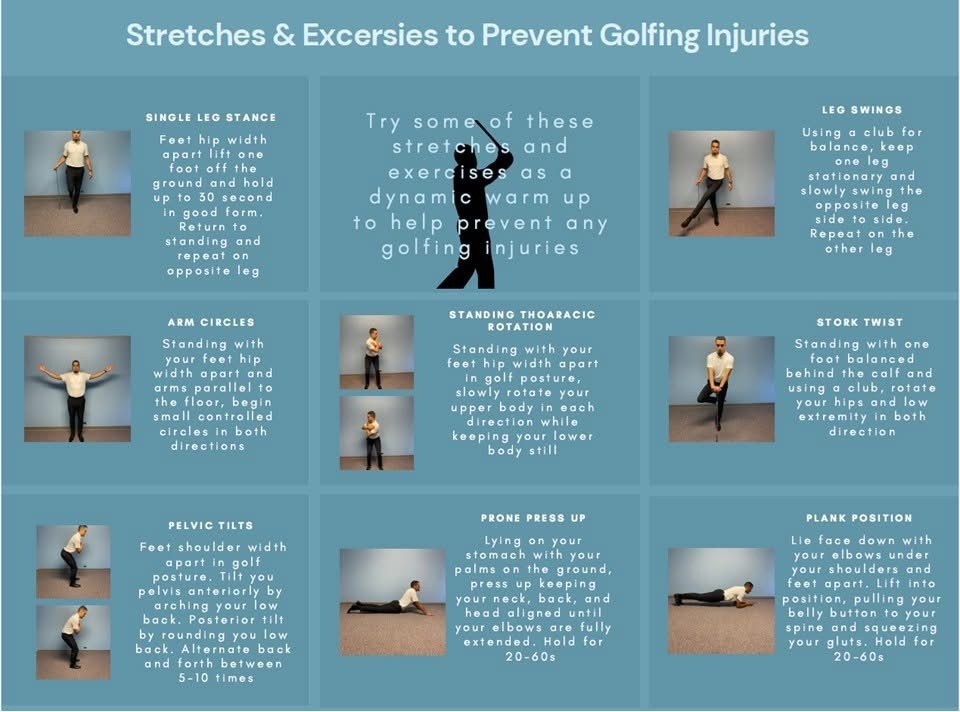
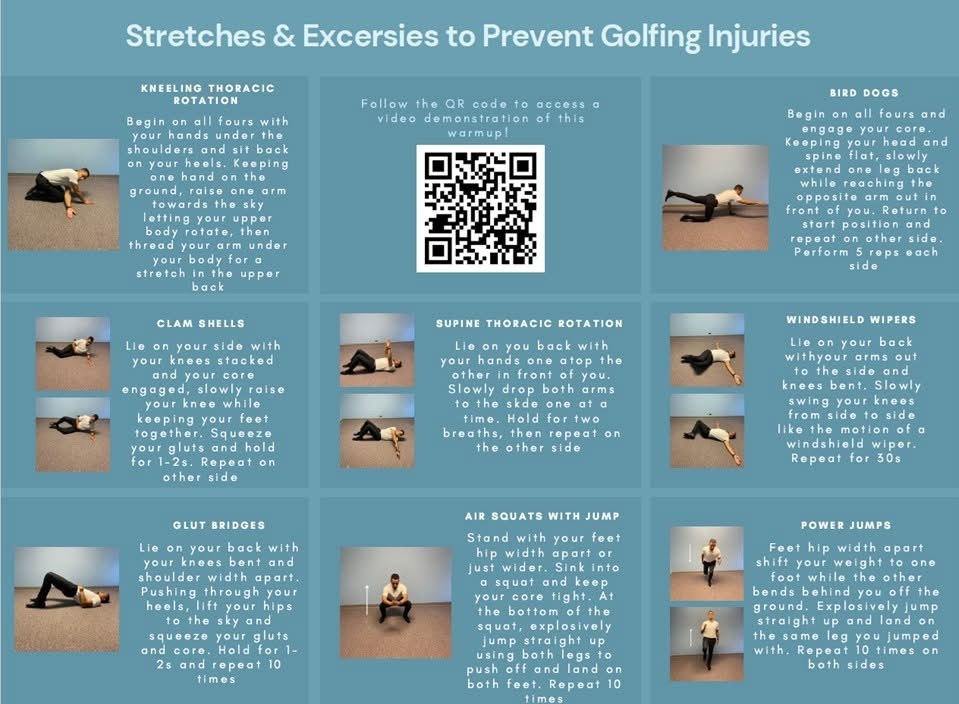
For the visual learners reading this article - there are two pages of exercsises accompanying this article courtesty of Dr. Tim Whiting.
How Chiropractic Fits Into a Golfer’s Routine
Chiropractic care works best when it’s proactive, not just reactive.
In-season:
- Maintain mobility and prevent stiffness from repeated play
- Address small issues before they escalate
Off-season:
- Correct imbalances
- Improve flexibility and strength foundations
During pain or injury:
- Restore motion
- Reduce inflammation
- Guide return-to-play safely
The Bottom Line
Golf performance isn’t just about technique—it’s about how well your body can execute that technique. When joints move properly and the nervous system functions efficiently, everything improves: swing consistency, distance, and durability.
Chiropractic care helps keep your body aligned with the demands of the game—so you can play more often, with less pain, and better results.

Kristopher Bradt
Contact Me